Utilities

Catch contract rate drift before utilities pay

Enforce rates buried in PDFs and supplier agreements, unify governance across business units, and maintain control through major ERP transitions.

Outcomes

1
Catch contract rate drift that PO matching misses: when the PO is valid but the invoiced rate or term is wrong
2
Enforce supplier terms buried in PDFs and side agreements before high-volume payment runs, without manual cross-reference on every line
3
Give finance leadership one group-wide control tower of prioritised exceptions, governance scores, and dollar exposure across business units and fragmented systems
4
Maintain pre-payment controls and audit evidence through ERP migration, when legacy and new systems run in parallel and leakage risk peaks
5
Govern non-PO maintenance and service spend where three-way match isn't feasible, with exception-led verification instead of uniform manual review

The Problem

Industry realities that create leakage, backlog, and control gaps.
PO matching helps, but it doesn't catch rate drift against contract
Supplier agreements sit in PDFs outside procurement systems; terms don't reliably flow into payment
Invoice volume is too high to manually cross-reference every rate against contract
Multiple business units, purchasing systems, and banking relationships fragment governance
ERP programs add transition risk when legacy systems run in parallel through change

How RedOwl Helps

Validate, verify, and govern: automate routine work while keeping real-time control on exceptions.
Invoice rates against contracted terms, including where contracts live in PDFs
Non-PO maintenance and service spend where three-way match isn't feasible
High-volume intake through a controlled AP Frontdesk workflow
Exceptions where the PO matches but rates or terms do not
Duplicates, bank changes, and other high-risk anomalies pre-payment
Live governance dashboard for finance leadership across business units
Prioritised exceptions and governance scores instead of uniform manual review

Key Use Cases

Click any use case to see when it applies, what it prevents, and who benefits.

How RedOwl Works

Every customer starts in a different place. The pattern below is consistent; data sources, sequencing, and rollout scope are shaped around your environment.
Discover and connect
We start with your stack, payment streams, and where control gaps show up today. Connection can be lightweight (exports or files) or integrated, depending on what you already run and how fast you need signal.
Validate what matters
You configure agents and policy rules around the checks that matter for your environment. RedOwl validates against contracts, master data, and thresholds before payment is approved, so scope follows your priorities rather than a fixed template.
Govern and scale
Exceptions route to the right people with evidence and governance scores. As confidence grows, you expand coverage, tighten rules, and deepen integrations at a pace that fits your team.

Industry Snapshot

Headline benchmarks on the true cost of manual invoice processing and the hidden workload that automation hasn't reached yet.
Manual vs. automated cost
$12.88 → $2.78
Average cost to process a single invoice manually, compared to best-in-class automated teams — a saving of over 78% per invoice.
Ardent Partners, State of ePayables 2024/2025
Hidden manual workload
~40%
Of invoice handling, validation, and exception management still done manually, even at energy companies that have already automated AP.
Beyond.ai, AI-Powered AP Automation in Energy
Procurement fraud as primary crime
~50%
The share of energy, utilities, and resources companies that experienced crime and reported procurement fraud as the primary incident, the sector's biggest threat, ahead of cybercrime.
PwC Global Economic Crime and Fraud Survey 2024.

Rate and policy exceptions by category

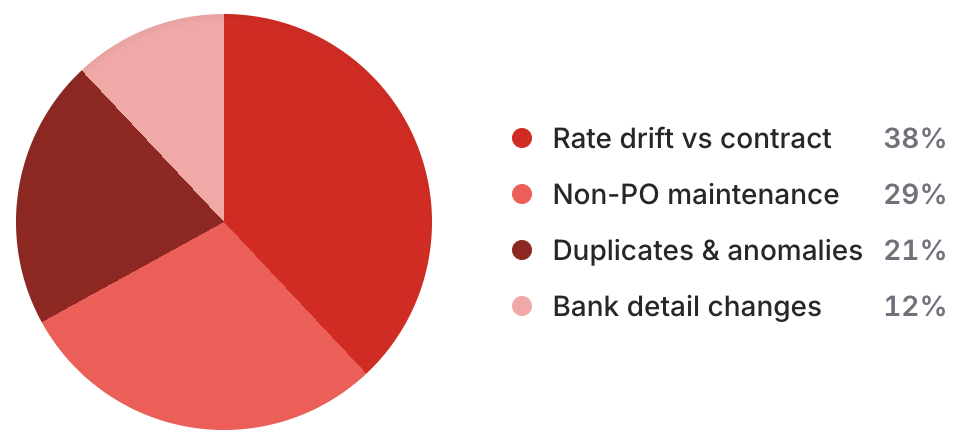
Typical exception mix across rate drift, non-PO maintenance, duplicates, and bank-detail risk in utility AP.
Rate drift vs contract
PO matches but invoiced rate or term does not. In utilities, supplier agreements for network maintenance, metering services, and field contractors are long-term and complex — rates shift with CPI adjustments, tariff changes, or contract renewals that don't flow reliably into procurement systems. This is the highest-frequency exception category in the sector.
Non-PO maintenance
Service spend without match-based controls. Reactive and emergency maintenance — field crews, equipment repairs, vegetation management — is frequently raised after the fact or under verbal authority. This spend bypasses PO-backed controls entirely and is a known leakage point in network operations.
Duplicates & anomalies
Repeat billing and data inconsistencies. High invoice volumes from recurring service providers (metering, field services, site management) create conditions for duplicate submissions — particularly across multiple business units or during ERP transitions where legacy and new systems run in parallel.
Bank detail changes
Payee verification before release. Supplier bank account changes in utilities are a known fraud vector — particularly for large, recurring payments to network contractors where a single redirected payment can be significant. Business email compromise targeting AP teams with fake remittance update requests is the primary method.

FAQ

Discover how RedOwl can supercharge your finance operations

Book a personalized demo of RedOwl's agentic platform, that transforms your finance operations

Book a Demo ->